Many things may happen when you go to the flea market in the weekend. That day I returned home with a 3 EUR catch - the Unomat B24 Auto compact flash, produced in Stuttgart in 1980s.
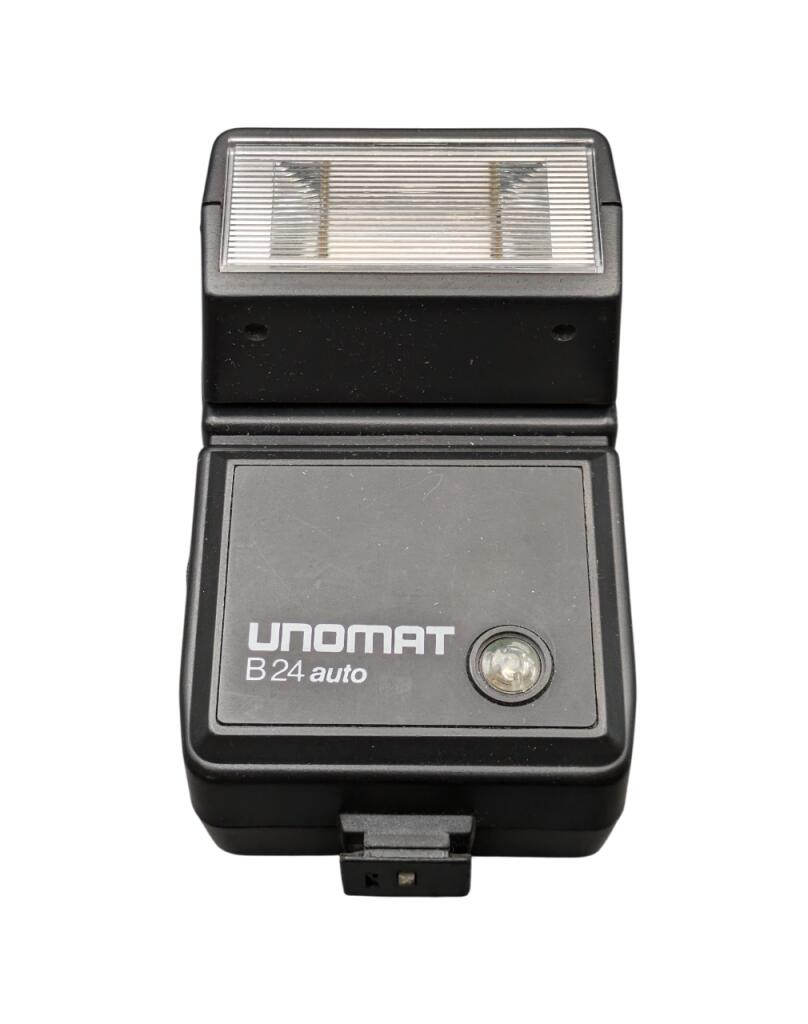
In fact, I was searching for a convenient flash solution for my Canon EOS 6D Mark II. This flash seemed convenient enough as it has flash trigger contacts on both the hot shoe stand, and the external jack connector. These flashes also have a very pleasant, “warmer” visible spectrum, easily compatible with modern cameras, due to the high flatness of the xenon filling’s ionisation energy distribution.
From the other side, the direct installation of this flash on the modern digital camera is a bullet to your own foot! As the most electronic flashes of the first generation, this one has only one pair of trigger contacts that opens both the ignition pulse and lamp power supply from the same capacitor. It requires the trigger contacts to pass through the full ignition pulse (about 400V, several microseconds) to the ignition transformer. It is how the analogue cameras with the synchronisation contacts worked, so for the old-school film camera, it is not a problem. From the other side, the modern digital cameras trigger the flash by passing their own signalling pulse (usually around 6V in peak) to the trigger contacts of the flash, which is expected to have a pulse detection circuit as a trigger. Thus, if the 400V pulse is passed through this circuit, it will likely be damaged or burnt away. This problem is, anyhow, very easy to solve. It requires just installing the thyristor gateway in between the trigger contacts, and driving it by the integrated optical triac, fed by either the internal power supply of the flash, or by the camera’s signalling pulse.
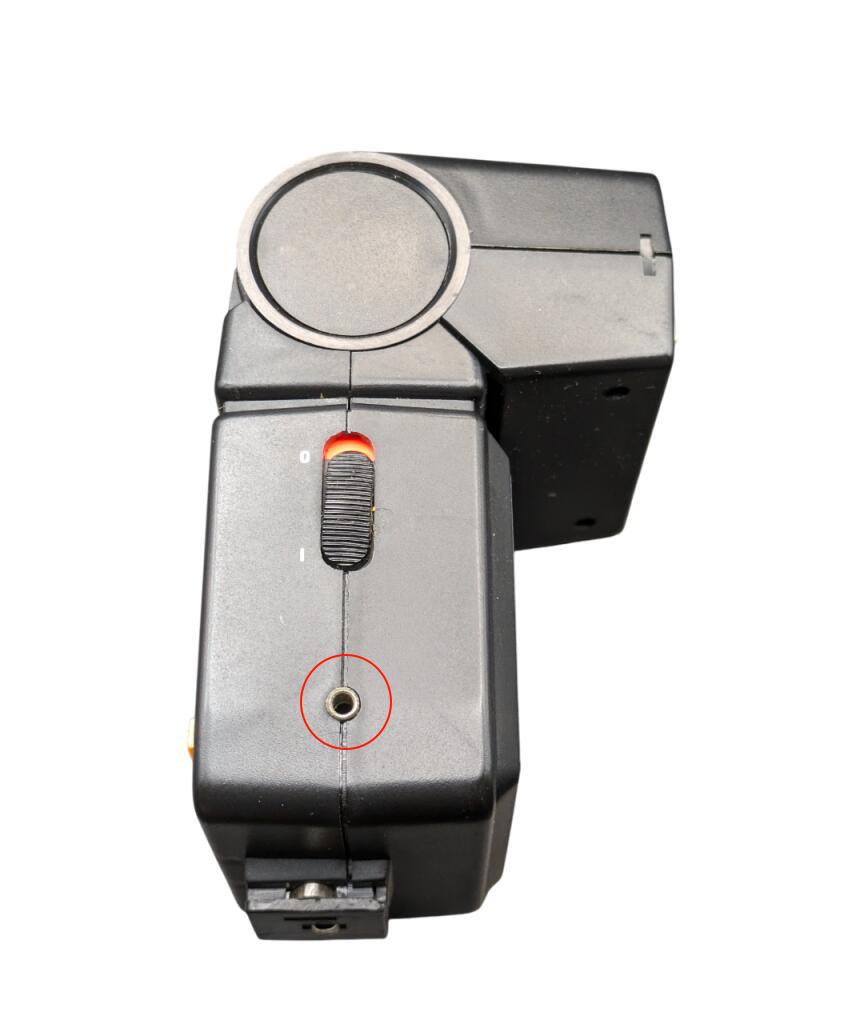
Before starting the adaptation, I charged the flash with the new batteries and measured the voltage between the trigger jack’s body (marked above) and the side contact on the hot shoe stand. The multimeter showed 247V, so the adaptation is surely required.
The circuit of the thyristor gateway is perfectly simple:
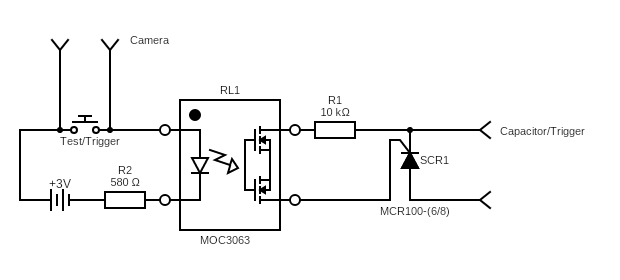
The polarity on the Camera connector sides should match exactly the polarity of the signalling pulse we have on the camera, so it is subject to change during justification of the circuit. It could also be useful to install the diode in between the battery and the trigger contacts, to prevent current backflips on the battery, but it is not strictly necessary here, cause the signalling pulses are very short.
The ignition pulse is initiated by opening the SCR1 thyristor gateway. The opening is triggered by the outer side of the RL1 optical triac. The capacitor’s voltage, max. 400V, dropped preliminarily by the dropping resistor R1, opens SCR1 passing the ignition pulse. So, the SCR1 thyristor is required to have a blocking voltage of more than 300V, with the gate voltage peak around 1V. The Motorola MCR100 series compact DIP thyristors, with a gate voltage peak of 1.2V, seem ideal to be used here. All the thyristors with the part index 6 or more (400V or more blocking voltage, consequently) are feasible.
The optical triac RL1 should be as small as it is possible cause there is very little space within the flash’s case. The selection of the DIP ones available is not wide; in fact, there is only the MOC30XX series available and widespread, so the smallest one, MOC3063, was selected. This triac has a maximal LED current of 5mA, so the value of the LED ballast resistor should be calculated from the typical power supply voltage of the flash:
where 3V is a maximal supply voltage, so for the normal triggering on short pulses, the standard 580 Ohm resistor should be successful.
After the primary assembly, the circuit was insulated with polyethene wrap and connected to the flash’s circuit points with the standard lacquer-coated wires. The circuit was placed flatly behind the frontal wall of the housing, above the exposure sensor’s window, and under the main printed circuit board. In the idle state, the voltage between the hot shoe’s contacts is 2.5V. The high-voltage triggering is still possible from the external trigger jack. The test performed during a real photoshoot has shown that the flash works in a stable way with Canon EOS 6D Mark II.

The above photo of my dear friend Eva, a perfect language teacher and the owner of Inglese e Altre Storie website, was taken with success using this modified flash!